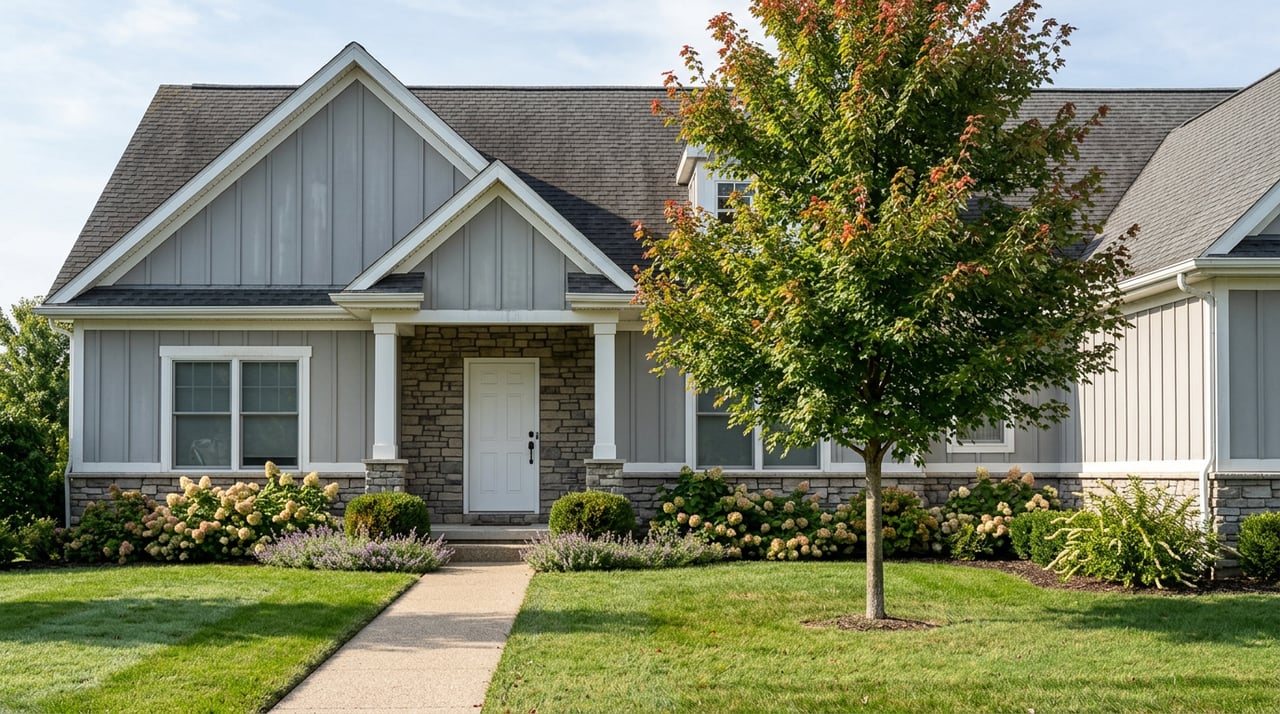
Bartlett IL Property Taxes by County: What to Know
August 20, 2026
August 20, 2026
A house in Bartlett doesn't care which county it sits in. The buyer comparing two listings at the same price does, or should, because the tax bill that arrives after closing can differ by thousands of dollars depending on which side of an invisible line the driveway falls on.
If you're touring homes in Bartlett's Cook County pocket this month, there's a timing wrinkle worth knowing before you write an offer. Hanover Township, the Cook County township that covers this slice of the village, went through its triennial reassessment last fall. Notices went out on November 6, 2025, and the new assessed values only just landed on tax bills mailed this July. That means the number your agent pulls from public records from a year ago, the one printed on last year's bill, is already out of date for any home whose value moved in that reassessment. Ask for the bill that arrived this summer, not the one from a year ago.
That's the small friction. The bigger one is structural, and it explains why the small friction matters so much here specifically.
Bartlett is one of the few Illinois villages that spans three counties. Most of it sits in Cook and DuPage, with a smaller slice reaching into Kane. That alone would be a curiosity if every county calculated property taxes the same way. They don't.
Illinois law says most residential property should be assessed at one-third of its fair market value, 33.33 percent. DuPage and Kane follow that rule closely, which is why their equalization factor, the multiplier the state applies to true up any county whose assessments drift from that target, sits close to 1.0.
Cook County plays by a different set of rules entirely. It assesses single-family homes at just 10 percent of market value, not a third. To keep Cook from quietly under-contributing to statewide school funding and other levies, the Illinois Department of Revenue applies a much larger equalization factor to bring that 10 percent back up near the statutory one-third. For the 2025 tax year, the one reflected on the bills that arrived this summer, the state set a tentative factor of 2.8683 for Cook County. Based on how the tentative number has moved to final in recent years, the finished figure for Cook typically lands somewhere in the high 2s to low 3s.
So a $500,000 home in the Cook County portion of Bartlett gets assessed at $50,000, then multiplied by roughly 2.9 to reach an equalized value near $145,000 before exemptions. A $500,000 home in the DuPage or Kane portion gets assessed at closer to $166,000 to start, with almost no multiplier on top. Two different paths, and in theory they're built to land in a similar place.
In theory.
Public tax-tracking data for Bartlett's three county portions tells a story that doesn't match the theory cleanly.
| County portion | Effective tax rate | Median annual tax bill | Median home value |
|---|---|---|---|
| Cook (Hanover Township) | roughly 2.9–3.2% | around $8,400 | around $300,000 |
| DuPage | 2.73% | $8,476 | around $314,000 |
| Kane | 2.91% | $10,855 | around $373,000 |
The rates across all three sit within shouting distance of each other, none of them wildly out of line with the others. The dollar bills do not.
Ask most people which part of the Chicago suburbs carries the heaviest property tax burden and Cook County wins that guess almost automatically. It has the reputation, the classification system, the equalization multiplier that sounds punitive on paper.
But inside Bartlett itself, it's the Kane County sliver, not the Cook County side, that produces the highest median tax bill in the village, over $2,300 more per year than either the Cook or DuPage portions. The rate there isn't dramatically higher. What's higher is the home value the rate gets applied to. A comparable rate multiplied against a bigger number still produces a bigger bill.
That's the piece of the puzzle a median price alone will never show you. Two listings priced identically on the portal can carry different tax futures depending on which county's assessment path they're on and, just as much, on how that specific pocket of the village has priced out relative to its neighbors. County reputation is a poor stand-in for the arithmetic on one particular parcel.
A few practical differences follow buyers around depending on which county a Bartlett address sits in, and they're worth asking about before you're mid-negotiation:
None of this is tax or legal advice, and every one of these dates should be confirmed with the relevant county office before you rely on it for a specific address. What it should do is change the question you ask. Instead of "what's the tax rate in Bartlett," the sharper question is "which taxing districts, school, park, library, and township, cover this specific parcel, and when was it last reassessed."
Before writing an offer on any Bartlett listing, it's worth confirming the county directly through the parcel itself rather than assuming based on the street name. DuPage County runs a public property lookup by address or parcel number through its own portal, and the Cook County Assessor's Office offers the same for parcels on its side. Pulling the actual PIN and its taxing district breakdown takes a few minutes and settles the question with certainty, rather than guessing from a map.
Does buying in the Kane County portion mean I'll pay Kane County's average rate? Not exactly. What lands on your bill is the composite rate for the specific taxing districts that cover your parcel, school district, park district, library, township, layered together. County-wide averages are a useful starting point, not the final number.
If Cook County's multiplier is so much higher, doesn't that make Cook homes more expensive automatically? Not by itself. The multiplier is designed to offset Cook's lower starting assessment percentage, and in Bartlett the two systems land close enough together that home values, not the multiplier, end up doing more of the work in explaining why one portion's bill runs higher than another's.
Should I rule out one county portion of Bartlett based on taxes alone? Taxes are one input among several, alongside school district boundaries, commute, and what a specific home actually offers for the price. A parcel-level look at the actual taxing districts tells you more than a county's general reputation ever will.
Bartlett rewards buyers who look past the sticker price and into the specific parcel. That's the kind of ground-level reading Nancy Winchester brings to every offer she writes here, pairing tax and school-district homework with the staging and presentation side of a purchase or sale. If you're comparing homes across Bartlett's county lines, or getting a Bartlett home ready to list on either side of them, start with an instant home valuation and staging plan and get the full picture before you decide.
Stay up to date on the latest real estate trends.
Born from a passion for both real estate and design, I bring a unique perspective to every transaction. With years of experience in sales and a trained eye for interiors, I help sellers showcase their homes with creativity and minimal expense, giving them a competitive edge in today’s market.

NANCY WINCHESTER
10 N Martingale Rd Ste 400 Schaumburg IL 60173